Monday, April 13, 2015

Music = Emotions = Life

            Emotions are a huge part of music and how music is interpreted. Think of your favorite music or music group. Got it? Now imagine that without any passion, with no feeling of any kind. It would sound awful, would it not? Music is emotions. Emotions are music. No matter what mood you are in, it is almost certain that you will be thinking or listening to some sort of music, whether it is to cheer you up, pump you up, or even to just escape life, it always creates some type of emotion in human beings.
            I personally believe that without music, life would be pointless. There would be nothing to rely on when everything else has abandoned you. Music surrounds us all whether we know it or not. Without it there would only be silence. Music is an emotional escape and without that escape people would find other ways to escape, for example killing each other. And if everyone killed each other there would be no sound, nothingness. Empty. The world would become a hollow shell that once inhabited an uneducated and primal species. Emotions are part of every human, without them they aren’t human, or just crazy, literally. Music is life and we all depend upon it.
            If you truly stop and really think, just listen, without headphones on, everything you hear can be called music. The cars racing by on the street outside your window. The birds and bees buzzing around and singing their weird song. The tapping of a branch on your window. The waves of a lake, lapping and carefully licking the shore. The silent crash of feet above your room. The beat of sweet neighborhood children jumping rope or shouting a cadence. The screech of your rusty door hinges. The heartbeat controlling your destiny and life. Just listen. It all comes together in a weird song, one that never dies, that will live on with the human race. It’s all there. Listen.

            This goes back to one of my previous blogs, in which I discuss the matter of running out of music. Emotions control us. There is no way to escape the inevitable, we are all prey to this wonderful animal. Take a moment and think, listen, and the answer will become as clear as glass. Music is a part of us all and so long as the human race lives on, so will music. 


Jazz Appreciation

            April is Jazz Appreciation Month. In the past, I have talked about Jazz: its effect on me, the disappointment that it brought, specific groups, groups I am personally involved in, and even jazz improv and theory. Clearly Jazz is important to me, but I don’t know if I’ve talked about how much I appreciate what Jazz has done for me.
            I didn’t really start to love or have as great of an appreciation for Jazz until about 2 months ago. My passion really started to grow when I went to one concert. This concert wasn’t any normal concert, it was with the University of Northern Iowa’s Jazz Panthers and Jazz One. At this concert I got to see what the next step in Jazz involved. I got to see professional musicians; not only the guest artist but the actual jazz bands themselves. It was an amazing concert and my eyes and ears were finally opened, as if I had been blind. After this concert I wanted to go home and spend the next 12 hours practicing, it didn’t happen, sadly.
            What made this concert so great you may be asking? Well, like I said it was professional musicians and seeing pros versus listening to recordings are two incredibly different tasks. It’s just like going to see a professional sports event, a professional Broadway production, a professional, you name it, it’s all the same idea. It’s the experience that inspires and strikes awe into the audience. Let me tell you, this concert was well worth the time and money; the experience was like none I’ve ever had before.
            Details. Right. Like I said before, the Jazz Panthers and Jazz One bands were both playing, but to put the cherry on top of a delicious sundae, a guest artist was brought in. This year the guest artist was Dave Douglas. He is a trumpet player involved in many groups; he has a quartet with Joe Lovano, previously mentioned in my blogs. He has also had many different awards, including Guggenheim Fellowship, an Aaron Copland award, and two Grammy nominations. He has composed many different pieces and highly influenced the jazz improv world. So this was really a treat for me to see and hear him live. Some of the pieces they played were amazing and made me feel energized and unlocked a whole new world in Jazz, I had never known I could feel this way about music. I was truly in awe and inspired after this wonderful experience.
            I walked out a changed man. Before all I had known was high school jazz band, now I know what a real jazz band and what real jazz music can do. The feeling of fear and the unknown had struck me. But along with this fear came an understanding of being fearless and unafraid. I had seen what lies ahead of me and am glad to take on the challenge.

            I finally understand what it means to truly appreciate Jazz. Jazz appreciation month has meant more than it ever has, I can turn on jazz and truly be inspired by the musicians of old, the greats who set the standards. All I have to do is follow their lead. How hard could that be?  

Monday, April 6, 2015

Very High In Pitch

            Altissimo. Weird word right? The definition for this word: Adj. Very high in pitch. It is an Italian superlative of alto, high. Now, to be clear, this is music we are talking about. It is the extreme high of instruments; these so called, “notes” aren’t even notes, meaning, they aren’t in the natural range of instruments. So when a musician plays in the altissimo register, are they even there? If the notes aren’t real, why are the musicians? If they aren’t real notes, how can we hear them? The answer, it would be hard to not hear them. Altissimo notes are like nails scratching a chalk board, except not quite as annoying. Very high in pitch.
            In the recent months, I have been learning the art of squealing; yes, I am learning how to master this technique. So far, I’ve done pretty well. Each time I practice the altissimo register it gets slightly easier and the notes are deciding to show their faces. I have gotten as high as, not the first, but the second D above the staff. That’s pretty high, only slightly annoying.
            What is altissimo though? I have given the dictionary definition. Now it’s time for the actual definition, or so what I’ve been told. The altissimo notes are really just a part of the overtone series.
            Another vague definition, right? What is the overtone series? That’s a tough question to answer. To start off, music is made by vibrations, no matter the instrument, something has to vibrate to create a sound. Within each of those vibrations are multiple notes; meaning, a G also has the same vibration pattern, or something of that matter, as C; meaning the overtone of G is C, but not necessarily the other way around. It’s the same concept as all squares are rectangles but not all rectangles are squares. Ok, now, stay with me. The overtone of C is actually C, not G. In other words, when playing a G a musician can make an altissimo C by adjusting their embouchure; or playing a high C and adjusting embouchure again to create the C above that C. Confusing yet cool.
            The other overtones: F-A# (or B flat), F#-B, G-C, G#-C#, C-C, B-B, etc.
            Got it? No? Ok.
Now, adjusting the embouchure. This is very hard to describe. I know exactly what I have to do on my saxophone to get into the altissimo register but I don’t know about other instruments. The best way I can describe this is that I almost make a clover with my tongue and flex my tonsil chords (this last part is impossible, I know, but there is no other way to describe it). It’s a weird feeling and that is what makes altissimo so difficult, there is no one specific way to form your embouchure, just like there is no one specific way to finger any one note.
Don’t even get me started on fingerings. There are an infinite, or so it seems, number of fingerings for any one specific note. Once a musician gets into the altissimo register, the details get a little sketchy and each person has to figure out which one is best for a certain situation.

A brief summary, altissimo is tricky. That’s the easiest way to put it. Altissimo clearly draws a line between good musicians and not-so-good musicians; those who can play altissimo well are amazing, those who can’t, well, you’ll be able to hear what happens, or not seeing as how your eardrums will most likely be bleeding. Altissimo. Very high in pitch.


Altissimo Notes
Altissimo Notes


Sunday, April 5, 2015

No Words

All-State Jazz is a difficult topic for me to discuss. It is an elite group of jazz musicians chosen from high schools all across Iowa. To audition for this elite group, you have to record an etude, which is the one song that everyone has to perform, and at least one song, of your choice, to improvise on. Preparing for this audition can end up taking months; I choose my song in December and took until February to at least get somewhat good at it. I spent almost 3 months of practice and stress, all, it seems, for nothing. My recordings were sent in on March 1st and I didn’t get the results back until March 26th. I thought my recordings were good but, in fact, they were not even close to good enough to make All-State Jazz.
          I love jazz. Every time I play or even listen to jazz, it’s as if the world is right, nothing can go wrong, all the fears and doubts of yesterday are washed away. Jazz is like a cool breeze in the summer, it is much needed and much appreciated by all; yet, there is always a feeling of discomfort on these breezes, as if there is always a looming storm, something to completely destroy everything in its path. In this instance, jazz took a turn for the worse; a tornado came and destroyed everything, tearing me apart as if I were an insignificant ant. I live for jazz but jazz doesn’t always live for me. I just can’t beat the onslaught that jazz brings towards me.
When I looked at the results, it was as if I had been sucked into the middle of a tornado; the world was spinning all around me, my confidence and hours spent on this task had been ravaged in seconds. I am bare and exposed, the storm of jazz took my possessions as if I were being mugged. I felt sick to my stomach and mad that I could not do better. My passion, jazz, was all a big lie, a slap in the face. Am I ever going to be able to recover? What more can I do to be able to improve my jazz skills? The answers…still to be determined. All I can think of doing is to continue to learn more improvisation vocabulary. I clearly don’t know how to develop an idea or know what exactly to play within each key, each song. The feeling of self-disappointment has almost overcome me, like a wave capsizing my ship of confidence. 
 
Words cannot fulfill my disappointment. I feel empty. I have failed myself. 


Monday, February 2, 2015

We Are #1

            We FINALLY did it! The 2015 Happiness Incorporated Combo got best band! The competition we went to was in Bloomington, Minnesota. It was four hours away and apparently we showed everyone up there what it’s like to compete in Iowa. I’m so glad I could be a part of the best band at this competition.
            The funny part is, we had more mistakes and aspects of the music that we didn’t execute as well as we have in the past. Apparently it was played well enough to beat out other bands, which still surprises me. For this performance we must have had better dynamics and musical aspects that were better than the execution of other bands. Listening to several different show choirs, there were definitely bands who were so tight with the group and played every note crisp. The only difference between us and them is that we had better dynamics or we blended better than the others.
            There was one band that I was sure was going to get the best band. It was from some ‘W’ school that I can’t remember the name of nor recall where they are from. But their band executed every note and were confident in all areas (which we lack sometimes, not always, but sometimes). They were so tight and together but the only thing I can think of that separated us from them is the blending and dynamics factor. In this area, I know we are really good. We are the perfect size so we can play loud and still not cover up the choir. If we were any bigger, or had any bigger sound, we might cover up the choir and their amazing tone which is something we don’t want to do. We have a pretty dang big sound as it is right now anyway. But it fits us, it fits the choir. We jam really well with each other.
            I’m not sure what the judges were looking for but we must have shown them the right thing. We were also the first group to go in the varsity division. So we must have just set the bar too high and the other bands couldn't get on our level. That is pretty impressive; if we can set the bar for people, imagine what it will be like when the others are surrounded by us, we are unstoppable.

            I am proud to say that I am part of an award winning combo and I can’t wait to see what the rest of this season has to hold. And Gramps, that one was for you! Thanks for giving me the ability and courage to bring Happiness to everyone.  

Best Band Award Bloomington 2015

Monday, January 26, 2015

IBA Honor Band=Kennedy

            Recordings of music. You hear them all the time. All different genres and playlists. The ones that are good get the attention of many people. But there are also ones that aren’t the best but get the attention of a couple people and suddenly that band is the IBA Honor Band for 2015. Yes, I’m talking about the Kennedy Wind Symphony. Somehow, our quality of music has raised to a level that makes us good enough to represent all the 4A High Schools in Iowa.
            In the past, I have gone on about how the Kennedy Wind Symphony has lacked work and determination. Does the phrase ‘Fake it till you make it’ sound familiar? Cause it seems that, not saying we aren’t good, we struggle through the process of sounding good. Apparently my standards are too high. Partially because of the fact that I made it into All-State Band. The whole experience with that band has dampened, or maybe heightened, the quality of which I want out of the Wind Symphony. In any case, I am stuck with what we’ve got and I am finally proud to say that I am involved in the Kennedy Wind Symphony.
            This whole process of getting into IBA is very time consuming and difficult. First off, we have to prepare music that is almost above our skill level. And then, when we kind of know that music we have to record it; where every mistake and cacked note is heard and there for the rest of time. Recording is such a stressful time. In a real concert, some of these simple mistakes can be covered up by different sections or parts of the music. But a recording is ruthless. It is like having the teacher stare over your shoulder while you are taking a math test; you’re afraid you are doing something wrong when you know you are doing it right, which, in turn, makes you mess up. It is a terrible feeling. Knowing that each entrance and every single minute detail will be heard and judged. Based on how many mistakes and errors the band makes determines who gets to take this great honor.
            Once recording is done, the bands involved send in their recordings to a panel of judges. These judges first listen to the first minute or so of the CD. If they don’t like what they hear, you’re done. With a flick of the wrist the hard work of a band goes into the trash can. They then decide, to those that weren’t that bad, to listen to more of the CD. Based on those tracks, they chose the band. Apparently, our CD made it through the judges and it was just not bad enough to make the band. So, on May 15th, the Kennedy Wind Symphony will be going to Des Moines to play for this amazing honor, the first time since 1972! 

Embedded image permalink

Jazz Season

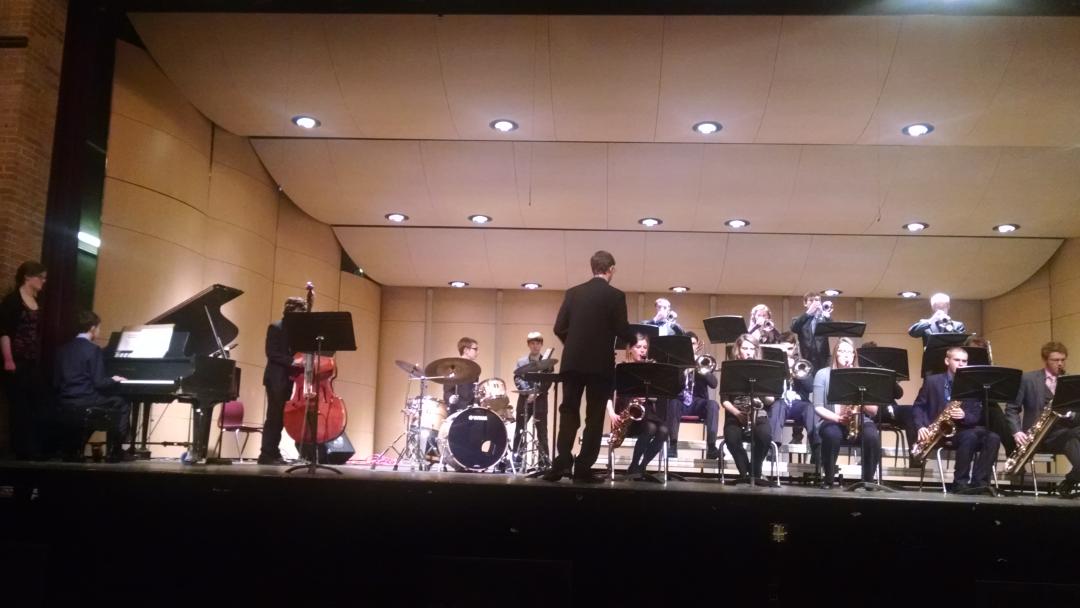
            The 2015 jazz band season is officially open! It’s the time of year where there are two or three jazz charts running through the musicians head. It is also the time when mistakes are no longer an option; where the music has to be felt instead of played; where jazz musicians go to be critiqued and ultimately die; where the weak fall and the strong rise up to shatter the knees of the lesser; where you find out, you may not be as good as you think. For Kennedy Jazz One, this is the time of year where we scramble to know the music well enough to not get last. Already we have started the season fast having competed at 2 competitions.
            The first competition was the Triton Jazz Fest at Iowa Central. At this competition there were only 2, 4A jazz bands battling for spots; both of which came from the wonderful school, Kennedy. Yes, at this competition we were the only school from 4A, competing against Jazz Two. In a way, not really a competition, more of a preliminary morale boost. It was a definite win and Jazz One did pull out the victory from Jazz Two. This is the very first, first place that I have received for jazz band in the three years I have been involved. I am proud of our victory but also know it was kind of pointless. After this competition, we don’t know where we line up with the other good 4A schools (for example: Washington, Prairie, Linn-Mar). We got a score and comments, sure, but that doesn’t show us what we have to compete against. It shows us that we are better than Jazz Two, (which, hopefully). In a way, although this was useful with the judges comments, it really doesn’t count. It was definitely a given, nothing we had to work that hard for.            Also at this competition, I received an outstanding soloist award, which, quite frankly, shocked me. I know I am not nearly good enough to have received this award at any other competition. This was just another pick me up that worked for a very short amount of time.            Just tonight we got done competing at the State Jazz Music Festival held at Jefferson High School. This was our first real competition where we got scored and given a rating. Now, because we just got done competing, I don’t know how we did. But based on the advice and critique the clinician gave us, it couldn’t have been good. Basically, he said that our band lacked energy and a sense of a good jazz feel. Not good. We definitely need work on out style and playing it with more passion. Sure, we are good at the technical stuff involved in jazz, but the non-technical stuff is way more important in jazz. For example: accents, phrases, staccatos, beats, etc. Most of these things are written on the page but jazz isn’t always about what’s on the page, it’s about how those dots and squiggles are interpreted by another person. We have a lot of tedious work ahead of us.            To end this not so great night, this clinician talked to me for what felt like 5 minutes about how my solo was crap. I went from the top all the way down to the bottom in a week. Apparently I am just terrible at everything. I try so hard but I just can’t seem to win, (except when there isn’t any competition). Overall, this past night was not a great night as my heart has been broken several times. 


 Embedded image permalink

Monday, January 19, 2015

Is Music Ever Going to Run Out?

            This week a question crossed my mind; will we ever run out of music? Music is my life. Every day I wake up with a song running through my head. Everywhere I turn I run into music, and I love it. Some people might call me a nerd for liking music and being obsessed over it and it is 100% true. I am ok with being a music nerd, it is what ultimately gets me through the day. Without music, life would be boring and bland, like cereal without milk. I would wake up and be empty, nothing to fuel my brain. The answer to this question, no, music will always be there.
            So what happens when all the possible melodies have been written? The only problem with this statement, the melodies are always going to be there, at least in my lifetime. There are so many different combinations of pitches that have not been written that there will always be different possibilities. The only problem is whether or not people can find these new melodies. It seems like there are many songs that have the same, or relatively the same, melody line. That could become a problem. If people just copy the same melody line but change the words, how is that different music?
I ran across a video that got my attention as it talks about this topic. It explains that even songs like God Bless America and God Save the Queen have the exact same melody, only different words. So how, if we haven’t already, ran out of new music? That is also explained in the video. Because there is such a large amount of different possibilities, we have not gotten to the full extent of our music statistically.


In my opinion, we will never run out of new music. Even though there are many songs that might sound alike, there is such a large amount of different melody lines that there is no way to run out of music in my lifetime. This is a relief to me. I don’t know what I would do without new exciting music to rotate my life around. 

1 Point Behind, 1 Place Ahead

            This past Saturday, the show choirs from Kennedy High School went to compete at Linn-Mar and did an amazing job. Protégé, the prep choir, received first in the prep division and went on to compete with the varsity division and proceeded to get 5th out of 6. After the day rounds, Happiness was in first and we would not step down; Happiness ended up in first place with best choreography and vocals.
Last but not least, for the most important part, combo. Sadly, but also awesome, the band did not get the best band award. The reason this is awesome is because, sure it was second, but it was second by one point. One stinking point! If we had done one aspect of music, one measure, one phrase better, we would have received best combo. It tears my heart out being one point away. We are so close.
One of the aspects that we could have done better in the day round was a grove. For some reason, we just didn't jam with the music as hard as we have in the past. It felt almost too pushed, like we were trying to force the sound and not embrace it. It is so important for our combo to feel the beat and have fun playing. Last year we had this problem; we didn’t let the music just come out of our instruments, it was forced. When bands grove and fit in with the singers, it’s amazing. It’s a whole level above those who just play and don’t put emotion behind the notes.
Emotion is what decides the best combo. Without emotion, the music sounds dead. It is a hard technique to master because a musician has to truly want to win, to convince the judges we are the best. Emotion is just so hard to put into an instrument. It’s not like we can just change what our face looks like, we can’t put on a façade like the singers can. They can almost fake their way with emotion but at the same time not. All aspects of music involved in a show choir involves some kind of emotion, some kind of feel. Whether that feeling is sad, or happy, or fun, or whatever, each person has to know what it should be like and use that to give the judges a show.
With emotion, our combo sounds so much better. During the night rounds, the grove and feeling of the show was incredible. I could tell that each person, no matter how tired, gave it their all. For the musicians in the combo, when playing for Happiness for the last time, it was the 4th show. There was even a trumpet player that had just danced her second show and was still willing to put everything into her instrument. It is just amazing that there was so much emotion and a sense of championship left that we blew the other groups out of the water.

After the night rounds, there was no doubt that Happiness was going to get first, and it happened. This was my first show choir championship ever and I could not be more proud to be involved with the group. Thanks to all the musicians who were willing to leave it all on the stage, to prove we deserve 1st


Monday, January 12, 2015

Preparation and Practice

            Preparation is the key factor in the lives of musicians. To perform well and not embarrass themselves, there is a certain amount of preparation and practice beforehand that has to occur. The amount of time spent on practicing will vary from one person to the next based on their natural skill and how much time they put in of practice time total. Without preparing, or preparing well, musicians would show up to contests and performances sounding mediocre.
            In many cases, this is one of the problems for the Kennedy Band program. Many of the musicians involved in the groups don’t want to practice on their own before rehearsal, let alone before a performance. This is a big issue. Groups do not sound good if the musicians don’t know their part or can’t execute it well. This is the story of all Kennedy Band ensembles; we can’t figure out how that everyone has to do their part.
            Not every section, or every person, is terrible. There are the few that are willing to do the work while others don’t see it necessary. So, when it comes to contests—in our case, recordings—we do not live up to our potential. The Kennedy Wind Symphony could be an amazing group, but we can’t pull it off if not everyone gives their all.
            This problem is like a disease; every ensemble: concert bands, jazz bands, and marching band, has a terrible case of laziness. For example, the jazz bands are going to a competition this Friday and we are not close to ready for competition season. We don’t sound quite as well as we could. The main problem, not everyone takes it seriously or practices at home. As much as I hate to admit it, I am victim to this disease as well. Even today I did not take home my music to practice. In fact, of the three years involved in the organization, I haven’t ever taken home music to practice. Not once have I done more than needed, minus practicing for my private lessons. I see no need to just like so many others in the groups. Except the difference is, I know my music and can execute it fairly well, at least that’s what I think.
            This problem will not go away for a long time. There is absolutely no incentive for the musicians to practice. It will be the downfall of the failing band program—if it hasn't burned it too much already. 

Sunday, January 11, 2015

Combo 2015

Show choir is a complicated machine that has to work almost perfectly for any results to occur. There are many separate parts that can be hard to combine to achieve the goals of the group. First, the singers have to dance, sing, and perform at their best, which is more complicated than it looks. Second, the tech crew has to be dead on with moving props and helping the soloists with mikes, all while being unseen. Lastly, the band, a.k.a. combo, has to provide the group with the music to sing to and it has to be perfect, in tune, on pitch, 100% accurate. All these make up a show choir and all rely on each other to sound and look good. 
I want to talk about the part I mentioned last, combo. I am in combo and play the bari sax for two of the three groups at Kennedy High School: Protégé and Happiness. I started last year with these groups and it was one of the best decisions I have made so far in high school. I made friends and found a new way to show off my skills with the instrument. It has been fun so far and have enjoyed the experience. 
Despite it being fun, I still have to work. Being the bari player, I am taxed with an important job; I have to keep a steady tempo and also provide a low voice in the instrumentation. Personally, I love the job. I get to jam and play some awesome music, at the same time that I provide an important sound to the band. I believe that the bari in combo is the best instrument; I get to play most of the fun, important lines and I get to do it loud. I can play super loud in this group without having the fear of covering up anyone. 
In the Protégé/Happiness combo there are 4 trumpets, 3 saxes (alto, tenor, bari), 2 (sometimes 3) trombones, a drummer, 2 keyboard players, a bass, and a guitar player. Overall there are a total of 15 players that provide the music for each show choir. 15 instrumentalists is a relatively small group but can hard to put together with the singers; we cannot cover up the singers but we also have to play loud enough to be heard by the audience. It can be a tricky balance and somewhat hard to hear playing behind the singers. Since we are in the back, and the singing is being projected opposite of us, we can’t always tell if we are too loud or if any one instrument is covering up the singers. Due to this fact, it is hard being in combo. We are criticized for being too loud and too soft. It takes many practices to get the balance perfect and everyone has to be committed to work for perfection. 
Another problem with 15 instrumentalists is that not everyone is as committed to it 100%. Some sections, especially last year, didn't want to put in the work or the time to sound good. They would show up to performances without practicing between rehearsal and the performance hoping it would be “good enough.” The problem, it wasn't even close to good enough. At the beginning of last year, about one year ago, the combo got dead last in the division. This did not help the choirs at all. The group would get in the top three for every division: choreography, vocal, etc., and the band would be dragging the score down being last in our division. The first couple competitions were slaps in the face and by the end of the year we were getting second consistently. 
This year, I am glad to say that we don’t have this issue anymore. By hiring a combo director, Ben Feuerhelm (my brother), the work ethic has changed and we sound better as a whole. With the addition of two new sax players, a trombone, and a great trumpet, our tone has evolved tremendously. This year we are able to jam as a group and sound good. Yesterday was our first competition and walking out of the auditorium, I felt really good. Last year at this time, I was walking out embarrassed; the group sounded terrible and I couldn't do anything to fix it. This year is a whole new story, I felt pumped and excited for our potential of this year. For the first time ever, our clinician said, “The combo either makes or breaks a group…this one didn't.” I am so impressed and proud to say that I am a part of the Protégé and Happiness combo. I can’t wait to see what this year holds. 
Overall, show choir is an organized clutter; and I only touched on one of the three. There are many wonderful musicians and people in these groups. I am excited to see what the rest of this year holds. 

Monday, December 22, 2014

Christmas Disaster?

Christmas musicals are usually happy and fills hearts with cheer. However, at Gloria Dei Lutheran Church, the Christmas program is hilarious to see. There are people that don’t know music and they rely on the few of us that are very successful musicians, mainly my family. 
This Christmas “Cantata” was an interesting adventure. To start this adventure off well, I was required to play an instrument I had never played before. It was a fun adventure but I didn’t know how to execute the tenor well enough to sound adequate. All the music for this was unison and the band consisted of a flute, cello, and tenor saxophone. Not a great combo to start out with. And then, to make matters worse, the songs I played on, I had absolutely no music. I was improvising the whole time by ear, without any music or chord progressions. 
I’m sure the audience didn’t mind the complete disaster because the Santa’s Saxes played before and after to wash the bad parts out of their minds. The music wasn’t bad, but it definitely could have been better. 


Sunday, December 21, 2014

Santa's Saxes

            Santa’s Saxes. A group composed of four musicians (a.k.a. a quartet). A group where I am 1 out of the 4. A group not connected by school, but by our private lesson teacher. Every year, Lynne Hart puts together a saxophone quartet (Alto 1, Alto 2, Tenor, Bari) which performs all around Cedar Rapids. I have the honor of being the Bari player. This group is one reason why I love this time of the year so much. 
            The amazing part about Santa’s Saxes is that not all the musicians are from the same school. People often ask, “So what school?” We all look at each other and stutter for a second before we introduce ourselves individually. In the group this year, there are three different schools represented: Kennedy, Washington, and Mount Vernon. It may be hard to believe that students from different high schools could get along but that is not the case at all. Through Santa’s Saxes I have made some friendships with people from different schools and I have enjoyed every year so far.
            Getting to the more interesting part now, the music. All of our music is arranged by Lynne and it is all interesting and fun to play and listen to. There are songs such as: I Saw Mommy Kissing Lawrence Welk, Rockin’ Around the Cheesy Medley, Let it Snow/Santa, and many more. All these songs have a twist to them that give them a fun atmosphere. In all the songs in our book, there isn’t one that you would be able to sing along to. Many people start to sing along cautiously thinking, “Yeah, I know this song.” And then, right as they start to sing more confidently, that’s when a twist in the melody appears that you would not expect; and suddenly, that person quickly looks around to see if anyone noticed them. It is actually pretty hilarious, knowing the music, when someone tries to sing along. We get to that part in the song where the melody changes and I hear the person who was singing slowly fade away with a confused sound in their voice. Some advice, if you are ever around to hear the Santa’s Saxes, just don’t sing, it’ll be more embarrassing for you.
            Anyway, I Saw Mommy Kissing Lawrence Welk. This song is an interesting song it starts off with the traditional, I Saw Mommy Kissing Santa Claus, and ends with some themes from the Lawrence Welk Show. Living and growing up in the 21st century, most people these days don’t understand the whole Lawrence Welk thing. The music for this show was really cheesy with heavy vibrato and incredibly short articulations. Since the show is rarely on anymore, most people just think it is a funny little diversion of a song. This song is fun to play at nursing homes because mostly everyone there has seen the Lawrence Welk Show and understands where the tune is coming from. To help out understand this song better, here is the Lawrence Welk show and the Santa’s Saxes rendition of I Saw Mommy Kissing Lawrence Welk.


            One of my favorite songs to play is Rockin’ Around the Cheesy Medley. This song is a compilation of 6 different “cheesy” Christmas tunes, including: Rockin’ Around the Christmas Tree, Holly Jolly Christmas, Here Comes Santa Claus, Jingle Bell Rock, Blue Christmas, and Santa Baby. It is a cool arrangement of the 6 different songs. I like it because it is fun to play and interesting all the time. You can form your own opinion, but this is one of my favorites out of the whole book.
            Another of my favorite, out of the two hour book, is Ukrainian Carol. This one has a cool base line that I get to play and it might just get stuck in your head, I know it gets stuck in mine. It is a fun version of Carol of the Bells and I love to rock out on it.

            I hope you enjoyed this selection out of the Santa’s Saxes book. To hear more fun songs, come out to Chick-Fil-A on December 22nd, 2014 between 5 and 7pm. 

Monday, December 15, 2014

Musical Cheer


            It is that time of the year, tis the season to be jolly, my favorite time of the year. Christmas. The most wonderful time of the year, as every song suggests. The best part about Christmas, the music. There isn’t one thought that runs through my head without music, no matter the time of year, but around this season, my thoughts are jollier, if you will.
I’m guessing that as soon as someone thinks of Christmas, their favorite carol or jazzed up version of it popped up in their heads. It’s inevitable, at some point in every human’s life a Christmas song has gotten stuck in their head. What makes a simple song about a reindeer so catchy? Any other song about, say, a squirrel with a glowing tail would just be weird. If you truly think about it, what is so significant about a reindeer born with a birthmark? It’s the simple, elementary, style of the song that we are taught as young children that just sticks with us.
All Christmas songs are taught at a young age, that’s what makes them so dang catchy. Every time the radio plays a rendition of simple songs such as Rudolf or Jingle Bells we can’t help but start humming along. We are all guilty, hell, even I can’t help but sing along to Sleigh Ride. It’s also what makes this time of the year so wonderful. The only time of the year where everyone gets along and truly cares for each other.
Christmas songs bring the best out of each and every one of us. Simple melodies bring flashbacks of simpler times, of times where you thought the world was perfect, of the times before you knew all the corruption and destruction the human race can bring. Essentially, Christmas is a time to repair relationships and build new ones. All this could not be achieved without the help of the cheerful music in the background.  

Remember that the cheer of the season is up to you, the music is only a kick start. I hope that your days may be merry and bright, may you have yourself a very merry, little Christmas. 


Sunday, December 14, 2014

Tenor Madness?

            Tenor. A simple word that has many different meanings: a vocal tenor, a clef, a range, a tenor sax. The latter is the most interesting to me. Saxophone is my specialty and I recently got the privilege of learning how to play tenor saxophone.
            You might be thinking, aren't all saxophones the same? You couldn't be more wrong. Every saxophone has a different personality that a non-saxophone player wouldn't understand. Each sax is like a person; no two are alike, each has a unique personality which a player has to figure out. The saxophone is an interesting object, you have to caress it and learn to love it or face the consequences.
            I normally play the baritone saxophone in jazz band and alto sax in concert band. Both these intricate machines have different sounds, tones, personalities. The bari is the low humming engine of a roaring Hummer, it always gets the job done. The alto is the high intoxicating sound of a Lamborghini, the more interesting and, in its own way, beautiful sound. Coming from the same family, these two machines could not be more different.
            And then there’s the tenor, the Challenger, not quite a tank but not quite a sports car. A beautiful machine that has the sweet purr that runs through your body, but also, a sense of power. I have gotten addicted to this wonder, tenor madness if you will. No, not tenor madness, but might as well be.
            Tenor is fun, it’s like nothing I’ve ever played. Last night, the first time I ever played a tenor sax, I realized why there are so many more tenor sax players known than any other sax. For example, to name a few: Ernie Watts, Joe Lovano, Sonny Rollins, Dexter Gordon, John Coltrane, Charlie Parker, Sonny Stitt. And that’s just the few off the top of my head. Tenor madness must truly be real. I've caught a virus that is all consuming, I can’t wait to let it take over, that is, if it hasn't already.
            I caught this bug all due to my church. This coming Sunday I am involved in a musical, if that’s truly the word for it. This virus overcame me when I was asked to improvise, without chord progressions I would later find out, and the instrumentation called for a b-flat instrument. I don’t own a tenor, (hard to get addicted to it then huh). I was planning to just play alto until I was offered a tenor to borrow for this one occasion.
            Instantly I took up this opportunity, as I have wanted to play a tenor for a while. The question is then raised, did tenor madness reach me before I had even touched the brass keys of a tenor? In any case, I currently have a bad case of tenor madness. I am figuring out how to play and sound good all for a silly children’s program at my church. This one time, I could not be more happy about the opportunity given to me.
            Perhaps this tenor madness could lead me to an award winning album, (I highly doubt it but go big or go home, right?) In all honesty this epidemic will most likely lead to further studies in saxophone. Maybe this is how all great musicians get their start, by playing at their churches. Only time will reveal the truth.


Monday, December 8, 2014

How do you DO that?

            Explaining music, how to play certain instruments, pitches, those wired dots, etc., can be a difficult task to anyone who hasn't touched a sheet of music. There are many factors that are involved in music that people may not realize. The simple concept of a major chord becomes difficult to explain.
            For many musicians, such as myself, the concepts come easy. When asked, “How do you do that?” is there any other answer than simply, “I just do.” Music is a hard concept to completely understand. To master an instrument or style, it may take years of practice and constant work to sound decent. Personally, I have spent the last 6 years of my life trying to master the saxophone. I have spent countless hours sitting in my room pushing myself to the limits. There are times when I have difficulty understanding a topic, such as the blues.These amazing musicians will be able to explain jazz better than I could: Ernie WattsJoe Lovano , Gerry Mulligan
            Over the weekend I was asked, “What is that you are chewing on?” I was at a gig over the weekend and I was getting ready, as usual, someone behind me asked this question. I turned around and said, in probably not the most respectful tone, “This is a reed. It’s what makes the sound.” I felt kind of bad afterwards because I realized my tone; I had spoken to that person in a condescending manner, like she was just supposed to know. It comes back to the main question, how am I supposed to explain something that seems so obvious to me? It’s hard to dumb something down when I have always been told, “This is the way it is and you will do it that way.” Is there a way where I can give a legitimate answer without sounding like a complete jerk? The answer, no. When it comes to music I just know the concepts and know what I can do to achieve my purpose.

When a complete stranger asks me, “How do you do that?” all I can say is, “Practice.” I can’t explain to them specifically how I do what I do because it would take 6 years to explain. I don’t mean to sound like a jerk but there are some musical concepts that I can't explain well enough. My lesson teacher once told me, "Don't practice until you get it right. Practice until you can't get it wrong." My best advice for those asking this question, pick up an instrument and try it for yourself. 

Sunday, December 7, 2014

68th Annual

The 68th Annual All-State Music Festival was one of the best in the history of the festival. Alright, I might be a little biased, for I was one of the top baritone saxophones in the state. This experience will never be forgotten in my memory. For better or for worse, it is stuck with me until the day I die. 
My adventure of All-State started with one of the most stressful auditions I have ever had. I usually don’t get nervous for auditions but for some reason, I was this time. I was standing outside my audition room feeling my heartbeat throughout my whole body. For some reason, unknown by me, I could not calm down. The fact that nerves got to me might have contributed to the failure that was my audition. To make it worse, the cellos went over their planned time which made me wait even longer, which, in turn, made my nervousness grow. By the time it was my turn to go into that torture chamber, I had become so nervous that I could hardly stand. It was a bad situation and the storm of nerves was heard through my instrument. It was not one of my best auditions but I survived. When I was finished with my audition, I had about an hour to wait until I received the chair placement; that hour felt like an hour of impending doom. Finally, I look up at the clock, the hour I had despised; it was time for the results. I walk into the room first, the judges look at me and quickly glance away, not good. At that moment I knew I had not made the chair I desired. They handed out little red cards, this card was the color of my blood and as I read the number on the card, the room began to spin. 4. Not good. One chair too low, no, 4 chairs too low. 
I walked out of that room into the smiling faces of my friends. They could tell by the look on my face that I was upset. They tried to comfort me and help me accept my position. Try as they might, I was still disappointed with myself and I wouldn’t accept my fate until later on that night. I started to realize that being the fourth out of sixth bari player in Iowa wasn’t that bad at dinner. There isn’t a better restaurant to bring my hopes up than Hickory Park. Hickory Park is, without a doubt, the best restaurant in Ames. When my food was finally brought out, all my worries and stress went away. I was happy and I accepted my chair placement after two hours.  
Auditions were only the first part of the adventure I took part in, I had two whole days that I was going to play in the best band in Iowa! The start of the second day at Iowa State would bring back the self disappointment, but it would quickly be washed away. When I got to Hilton Collesuem and found my seat, in the very back, we warmed up and I finally met the person who I was stuck with for the next two days, the director. His name is Dr. Andrew Mast. He is an intersting person; he uses many analogies to explain how a part of the music is supposed to sound. My favorite was, “That tympani line should sound like orc drums getting ready for the battle.” It was a great way to describe a sound to copy. Most of the comments he made were confusing to other people; not me though, I take from Lynne Hart and have to be able to decipher strange analogies. One of the wierdest analogies he told us was something about a hamster ball and how the song is supposed to, somehow, make an impression like that. Can you tell it was a fun weekend? I enjoyed being part of Dr. Mast’s band and was glad I had that learning experience. 
Apart from the intersting director, the music was some of the best I have heard produced by high schoolers. Going from the Kennedy Wind Smphony to the All-State Band was mind blowing. The best part about it was that every section knew their music, every single one! There wasn’t a weak link, everyone there wanted to play and were good at it. From the first note, to the last, I was never disappointed or annoyed. Every section sounded amazing. At the concert, I looked up at the audience and saw total engagement. Our set was interesting and we were good enough to pull it off. I loved the experience at the end of the whole stadium standing on their feet and clapping, not out of pity, but because it was just that good. I can only hope that the 68th All-State Band was able to inspire and bring enjoyment. 
The All-State experience was wonderful, I learned about myself, about where I was in the ranking of bari players in the state, about what a band should sound like. I couldn’t have asked for a better weekend. I can’t wait to go back next year!


Monday, November 3, 2014

Madness

Madness. A feeling I experience and question whether or not I am truly mad. The song Madness by Muse is a song that is interesting at the same time that it describes my personality. 
This techno/hip-hop song has many different moving parts and a driving beat that make it appealing. To me, the slow start gives the climax a stronger effect. By starting out with a strong beat and a quiet entrance, there is more to build upon than if it was a sudden loud start. At the beginnings of songs I like quiet starts or low sneaking entrances; just like in Madness when the driving beat starts. I also like the mixture of techno bass with the electric guitar and sweet tones of the singer. 
Overall, there is a nice balance between new sounds with nice vocals to back it up. I like how Muse put together this song and the overall effect of the driving tones and strong harmonies.


Sunday, November 2, 2014

Rooms of Music

There are many different kinds of music: music that is soft and soothing, music that fills your soul with joy, and music that gets you excited. To me, music influences my actions. Without music I would not be able to function. 
I don’t have any one genre that pumps me up or makes me happy. I listen to all different kinds of music and it all depends upon which room I am in. For example, if I am alone and just trying to relax, I usually listen to jazz or some slow soundtracks, if I am in the weight room lifting, I tend to listen to rock or country. It depends upon the activity that I am doing as to what music I’m in the mood for. 
When I work out, I tend to listen to rock or music with a hard beat. It gives me more power when I hear the strong chords of an electric guitar rather than the soothing tones of a sax. Rock music makes me push harder than I would without music or any other kind of music. I’m not sure whether it is the beat of the drums, the hard bass, the rhythmic changes in the guitar, or the compelling voice of the singer that makes me feel this, but something in my mind changes whenever rock is turned on. There really is no other reason as to why rock has this affect on me. As soon as Thunderstruck by ACDC is turned on, the electricity flows through my veins, I feel more excited than I usually do. If rock music isn’t on when I work out, I feel as if I didn’t work as hard, as long, as much as I could have with it on. 
On the opposite side, jazz usually makes me feel more relaxed and mellow. If I need to unwind from the day, I can turn on the awesome beats of jazz players such as: Gerry Mulligan, Charles Mingus, Joe Lovano, Ernie Watts, Etienne Charles, Art Pepper, etc. The list goes on forever. That is what I love about jazz; each player brings a different element to the field, a different sound and style that no one can copy. When I listen to jazz I always hear something new: a new idea, a new technique, a new rhythm. Unlike another kind of music, jazz cannot be copied by another person. There can be new ideas and different styles of the same piece, but there are not two jazz players that are alike. If you look at other genres, the style and sound can be copied by a computer, but no machine can insert a human element into jazz. Jazz is, and always will be, the last of the genres that is truly soulful, that is played from the heart. That is why I love to relax to jazz, every piece is played with passion. 
Through music, my personality has changed, through music I am able to change my mood, through music I am able to create my mood. Music is the best tool for relaxing and for getting excited. Each person just has to know what each style of music does to them in order for music to be used for different situations. 

Band Teeter-Totter

Playing in an ensemble is harder than the musicians in penguin suits make it look. To be a successful and good sounding band/group, there has to be a balance of the vibrations of every different instrument. If one section thinks they are heroes and plays too loud, then the rest of the band will sound insignificant. The band is like a teeter-totter; without a counter balance, it wouldn’t be fun, and without balance between the sections the band wouldn’t be entertaining. 
I have to deal with this careful equilibrium every day in band, just as any other good musician would do. I am constantly listening to the people around me and fitting into their sound and balance of the band. The best balance that a band could achieve is more on the lower end and less on the higher end. That means that the low brass, such as tuba and trombone, have to play out more to achieve an amazing balance. It also means that the other sections have to listen to the lower instruments to fit into this texture. The whole point of an ensemble is not to make yourself sound good, but to make others sound better. Without careful balance, a song will be too heavy in one instrument; to the audience, if the trumpets play louder than the other sections—which is more rather than less—the other sections would sound small and like they aren’t even playing. Sadly, the Kennedy Wind Symphony has troubles figuring out what the correct balance is. Even though I, and my section, listen and fit our sound with the band, it doesn’t help if another section doesn’t listen. Band is probably one of the biggest team activities that I know. If one person plays the wrong note, or is too loud at a certain time, then the whole song has a negative effect on the listeners. 
Generally, in the Kennedy Wind Symphony, the section that usually sticks out is the trumpets. I don’t know what it is about the trumpets that makes them think that they are better than any other section but I think that is part of the problem. Because they think they are better than everyone else, they might think that they should be allowed to play as loud as they want, whenever they want. That is what makes the wind symphony sound bad; the trumpets don’t want to accept that there are other players in the band. What makes it even worse, is that the trumpets don’t have the best sound so when they do play out it drops the whole band a couple of levels. If the trumpets were good I wouldn’t be as upset when they play out when they shouldn’t. 
The key to a great band or small ensemble is balance; without it, bands would not sound as full or effective. Without balance the teeter-totter would merely be a stick lying on the ground. I always try my best to make the band teeter-totter fun and enjoyable, I just wish the rest of the band would see this and jump on.